The geology
How Sapadere Canyon was formed
Guests ask this on the walkway, usually while looking straight at the answer. The gorge is cut into limestone, and limestone is one of the few rocks that water can dissolve outright as well as grind away.
Atalay Tour, Alanya
The rock does the deciding
Every gorge is an argument between a river and whatever it is running over, and the rock settles how the argument goes. Put the same river on granite and you get a shallow valley with a stony floor. Put it on limestone and you get this: a slot with walls that reach about 400 m in places, water for a floor, and no room at the bottom for anything but the river.
Limestone is mostly calcium carbonate, and most limestone began as shell and carbonate mud on a sea floor, compacted and then lifted into a mountain range long afterwards. That history matters less than one chemical fact. Rain falls through air and soil, picks up carbon dioxide on the way and arrives as a weak acid. On most rock that acid achieves very little. On limestone it goes to work, and it never clocks off.
Everything you look at from the walkway follows from that. The shapes are not weathering in the ordinary sense. They are a rock being taken into solution and carried away.
One crack takes everything
Water does not attack a hillside evenly. Limestone is full of joints — the cracks and bedding planes that open as a mass of rock is folded, lifted and relieved of the weight that once sat on it — and water goes down the joints because that is where the space already is.
What happens next has no brakes in it. A joint that takes slightly more water is widened slightly faster; a joint that is slightly wider takes more water the next time it rains. One line through the ridge wins, and every rival line is left dry and forgotten. That is why a limestone canyon is a slot rather than a basin. The winning crack collected all the water, and the water spent it going down rather than sideways.
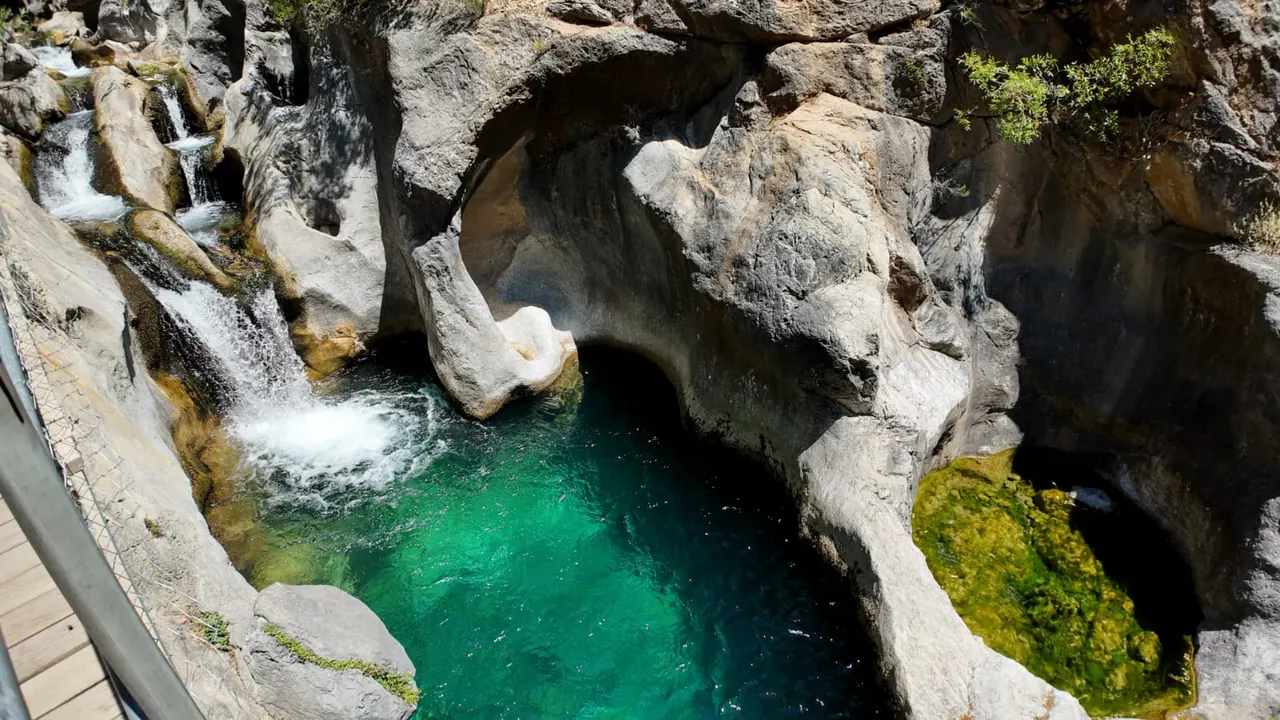
The proportions you walk through are the receipt for that. The cutting ran far ahead of the widening, which is why the sides rise instead of stepping back, and why the floor is river almost the whole way, with little more than the odd shelf of rock beside it. When somebody eventually decided the gorge should be walkable, the geology had left nowhere to put a path except on the wall itself.
Two tools, and the loud one works in bursts
Solution is only half of the work. The acid is patient and constant: it operates on every wet surface, all year, including the months when the river looks harmless. The grinding is the other half and it comes in short violent instalments. After heavy rain the river carries sand, gravel and stones, and a river carrying grit is a file being dragged along the rock.
Most of the shaping is done on a handful of days each year when nobody is in the canyon at all. That same flood water is why access here can be limited after heavy rain, and why a date gets moved rather than forced: the water that is doing the carving is not water to be standing beside.
Both tools bite hardest at the waterline and just below it, because that is the band where moving water is actually in contact with stone. So the wall is eaten out at the bottom while the top is left leaning over the gap. Every overhang in this canyon is a piece of wall that lost its footing before it lost its face.
Reading the walls
Once you know what made them, the surfaces stop being scenery and start being a record of how water moved at that exact spot. Four things are worth looking for, and which of them you find depends on where the walkway happens to run close to the rock.
- Scallops — shallow asymmetric hollows in rows, like the inside of an egg box pressed into stone. They form under fast water, and as a rule the faster the flow the smaller they are.
- Flutes — vertical grooves running down a face where water came over the lip instead of around it, each groove deepening itself the way the original joint did.
- Potholes — round holes ground out by a single stone caught in an eddy and spun in one place until it wore its own socket. Some are no deeper than a saucer; others have been worked down into a proper socket.
- Polish — the pale, rounded, almost soapy stone low down, against rougher grey and lichen higher up. The line where one becomes the other is roughly where the river gets to when it is in flood.
Why there is deep water under every fall
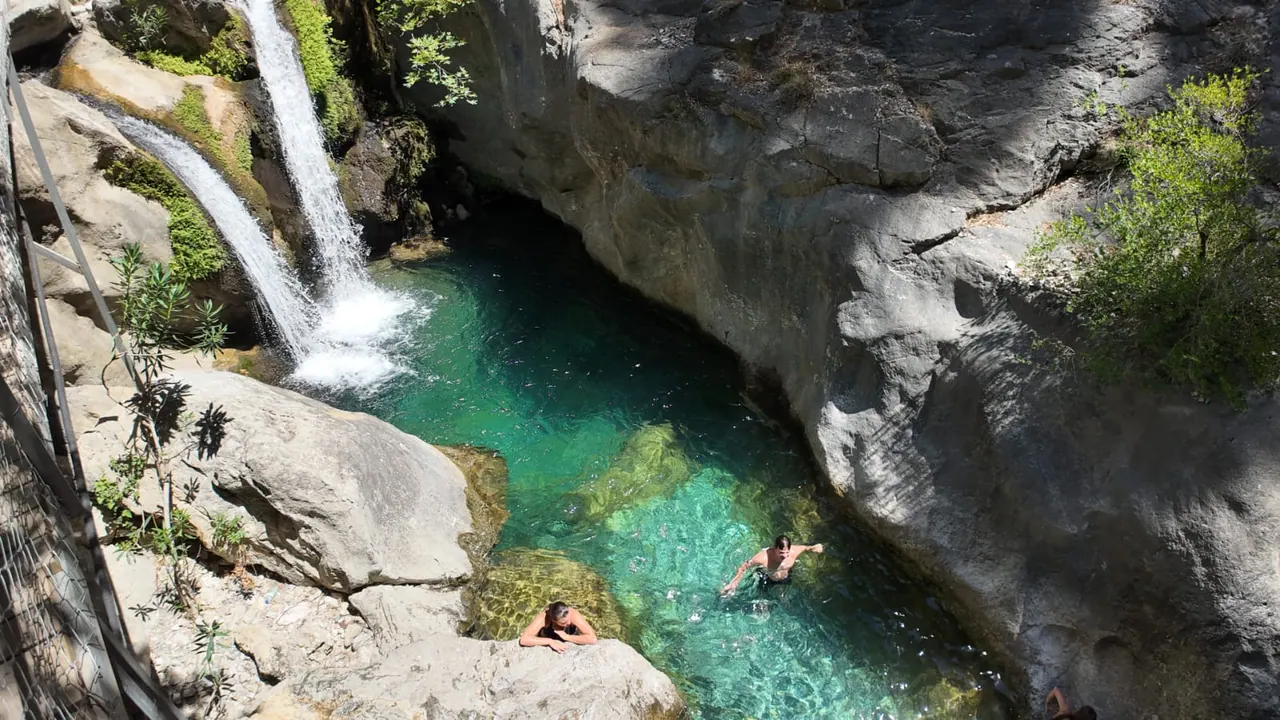
A waterfall lands with force and it lands in one place. The falling water, and the gravel it brings down with it, drill straight into the bed — so the basin directly beneath a fall is deeper than the channel above it and deeper than the shallows downstream. That step in depth is a large part of why the pools read dark green in the middle and clear turquoise at the edges, and it is why the swimming happens where it happens rather than anywhere along the river.
The fall is also quietly undercutting its own lip. Spray and the rebound off the pool eat back into the rock behind the falling water until the overhanging lip is carrying more weight than it has support for, and it drops. The fall re-establishes itself a little further upstream and starts again. A waterfall in limestone is not a fixed feature of the landscape; it is a retreat in slow motion, and the ones at the end of the walkway are simply where that retreat has got to.
It is also why the falls arrive as a flight rather than one clean drop at the end. Limestone is not uniform: some beds are thicker, harder or less jointed than the ones above and below them, so the river gets through the weak layers quickly and stalls on the strong ones. Every stall becomes a step, every step then retreats at its own rate, and what you end up walking beside is a staircase of cascades and basins rather than a single fall.
The same rock, hollowed from the inside
The canyon is only the part of this process that reached daylight. Water sinking into limestone largely stops running off the surface: it goes in, and underground it dissolves passages along the same joints for the same reason. When a valley cuts down past one of those passages, the passage drains and becomes an air-filled cave. The Cüceler (Dwarfs') Cave near the canyon and the gorge you walk through are one process at two depths, which is why they sit so close together.
The chemistry also runs backwards, and that is the half people miss. Water that dissolved carbonate on the way through gives some of it back wherever it splashes and aerates, laying it down as a crust on whatever it lands on. That is the tan and rust-coloured lumpy stone beside the cascades. Inside a cave the same reaction, slowed right down and dripping instead of splashing, builds stalactites. The canyon is being dismantled and rebuilt by the same water within a few paces of itself.
One consequence of all this is worth noticing on the drive in. Limestone country tends to look dry on top, because the water is not on top — the slopes above the gorge can be parched through August while a river is running hard at the bottom of it. The rock takes the rain in, moves it out of sight along its own joints and hands it back at springs. That is how a gorge this narrow keeps water in it all summer when the hillsides plainly have none. What the temperature of that water then does to a person is a separate subject, and it has its own piece in this journal.
None of this is needed to enjoy the walk. But the canyon reads differently once the overhang above the pool, the hollows and flutes on the wall and the dark water under the fall stop being three sights and become three results of one thing — a thing that is still going on while you stand there looking at it. If a stretch of wall puzzles you, ask your guide about it on the way past.
FAQ
Frequently asked questions
What kind of rock is Sapadere Canyon?
Limestone — pale, close-grained and full of joints. It is the rock that makes this kind of gorge possible, because water can dissolve it outright as well as wear it down. Rock that only wears down gives you a valley, not a slot.
How old is the canyon?
Nobody on this tour measures it and no age is on our record, so we do not publish a figure. What is safe to say is that the rock is far older than the gorge cut into it, and that the cutting has not stopped — what you walk through is a stage rather than a finished thing.
Is the canyon still changing?
Yes, mostly on days when nobody is in it. The quiet summer flow does the chemical work on every wet surface; the floods after heavy rain move the stone. Between them they deepen the pools and walk the waterfalls slowly upstream.
Was Sapadere Canyon a cave that collapsed?
Nothing visible here says so. A collapsed cave leaves its roof in pieces on the floor; these walls are smooth and undercut at the waterline, which is what a river cutting down a joint leaves behind. Caves and canyons are the same chemistry working at different depths, which is probably where the idea comes from.
Not answered here? Ask us on WhatsApp
Read next
Sapadere Canyon's waterfalls and the wooden walkway
The walkway, the walls, the cascades and the pools, described as they are rather than as a brochure would.
Read more →Sapadere village: the mountain village the canyon is named after
The village behind the canyon: what the tour passes through, and why no village stop is promised.
Read more →Sapadere Canyon: the guide before you book
Where the canyon is, how far, how long, what you see, swimming, children, packing, tour versus car, best time — the pillar page.
Read more →The Sapadere Canyon tour specialist
Ready to explore Sapadere Canyon?
From 33 € per person · free hotel pickup · pay on the tour day · free cancellation up to 24 hours before.